Learn About our Suggested Partners Agent
An overview of how Suggested Partners works, what's new, and what to expect in results.
Written By Amalia Busch
Last updated 5 months ago
Quick take: at a glance
✨ What it does
When you create an Opportunity (a campaign centered on one technology or a portfolio of related technologies), Tradespace's Suggested Partners agent identifies and ranks companies that are most likely to:
License your IP
Co-develop it
Invest in it
Otherwise help commercialize the innovation
The goal is to help you quickly build a targeted outreach list—grounded in both technical relevance and real-world partnering behavior.
How it works (end to end)
🔎 The pipeline: from Opportunity → ranked partners
Suggested Partners runs through a set of stages to go from your Opportunity to a ranked list of companies.
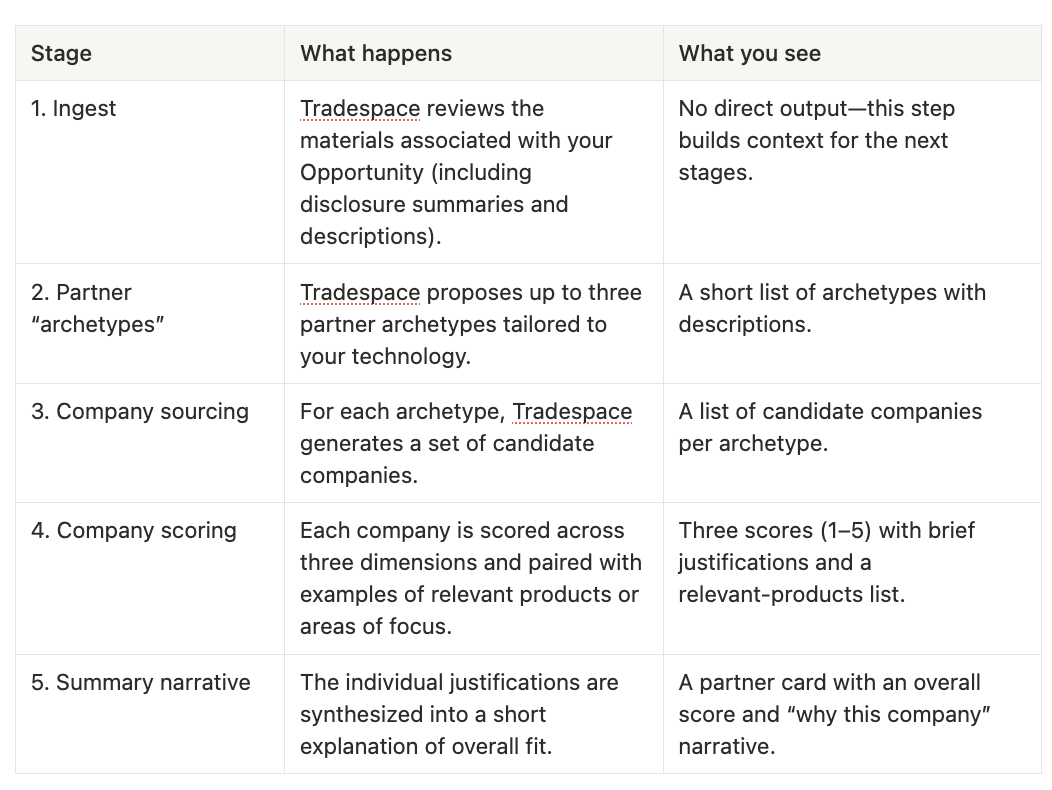
🧭 The AI's point of view adapts to your organization type to better reflect common partnering realities (for example, university technology transfer vs. corporate licensing workflows).
Key concepts
🧩 Partner archetypes: the lens that shapes your results
Archetypes shape everything downstream. If you're surprised by the companies you see, the explanation often starts with the archetypes chosen for your Opportunity.
What is an archetype?
A partner archetype is a type of company, not a specific company, defined by things like:
business model and scale,
how the company typically develops new technology,
relationship to your invention's mechanism or application,
the stage of development your innovation is currently in.
Examples might include a focused specialist, a later-stage commercial incumbent, or a venture-backed company building around a similar platform.
Principles you'll see reflected in results
Mechanism over broad industry labels. Core technical mechanism and application are often more predictive than industry category alone.
Specialists can be the best early development partners. For early-stage innovations, smaller companies building around a specific mechanism can be more aligned than large incumbents.
Strategic incentives matter. Companies are less likely to be suggested if the invention would clearly conflict with their existing core revenue.
Spin-out recommendations can be appropriate. If there's no natural "home" for the invention, you may see indications that a new venture path could be more viable.
🎯 How we pick companies (inputs + filters)
For each archetype, Tradespace identifies specific companies that match the archetype and your Opportunity context. This selection is shaped by:
your Opportunity's context and filters (e.g., geography, company type),
quality and availability of public information.
Defunct companies are excluded.
Scoring: what the numbers mean
📊 Scoring explained (how to read 1–5)
Each company is scored across three dimensions on a 1–5 scale. Scores are designed to help you compare candidates consistently.
1) Partnership likelihood
What it answers: How likely is this company to partner with external innovators to commercialize new IP?
Scores reflect signals such as partnership posture, external collaboration patterns, and indicators that partnering is a meaningful part of the company's approach.
2) Technical & strategic fit
What it answers: How well does your innovation match what the company builds today—or is credibly moving to build—and how strategically important that area is to them?
This is about both alignment and priority.
3) Financial readiness
What it answers: Does the company appear positioned to fund licensing, development, and the time required to bring innovations to market?
This evaluates readiness relative to company stage (for example, well-funded startups can score highly alongside stable incumbents).
📌 About data gaps: When public information is limited, scores may be more conservative and explanations may explicitly note what's unknown.
Helpful context & how to use it
🧠 Relevant products: how to use them in outreach
Alongside scores, Suggested Partners may include examples of the company's products or focus areas that appear most relevant. This is meant to help your team:
tailor outreach messaging,
identify the best internal stakeholder at the target company, and
make conversations more specific than "we have a technology you might like."
Was this helpful?